
From the Real World to OFMOS, and Back — A Pursuit-of-Success Cycle
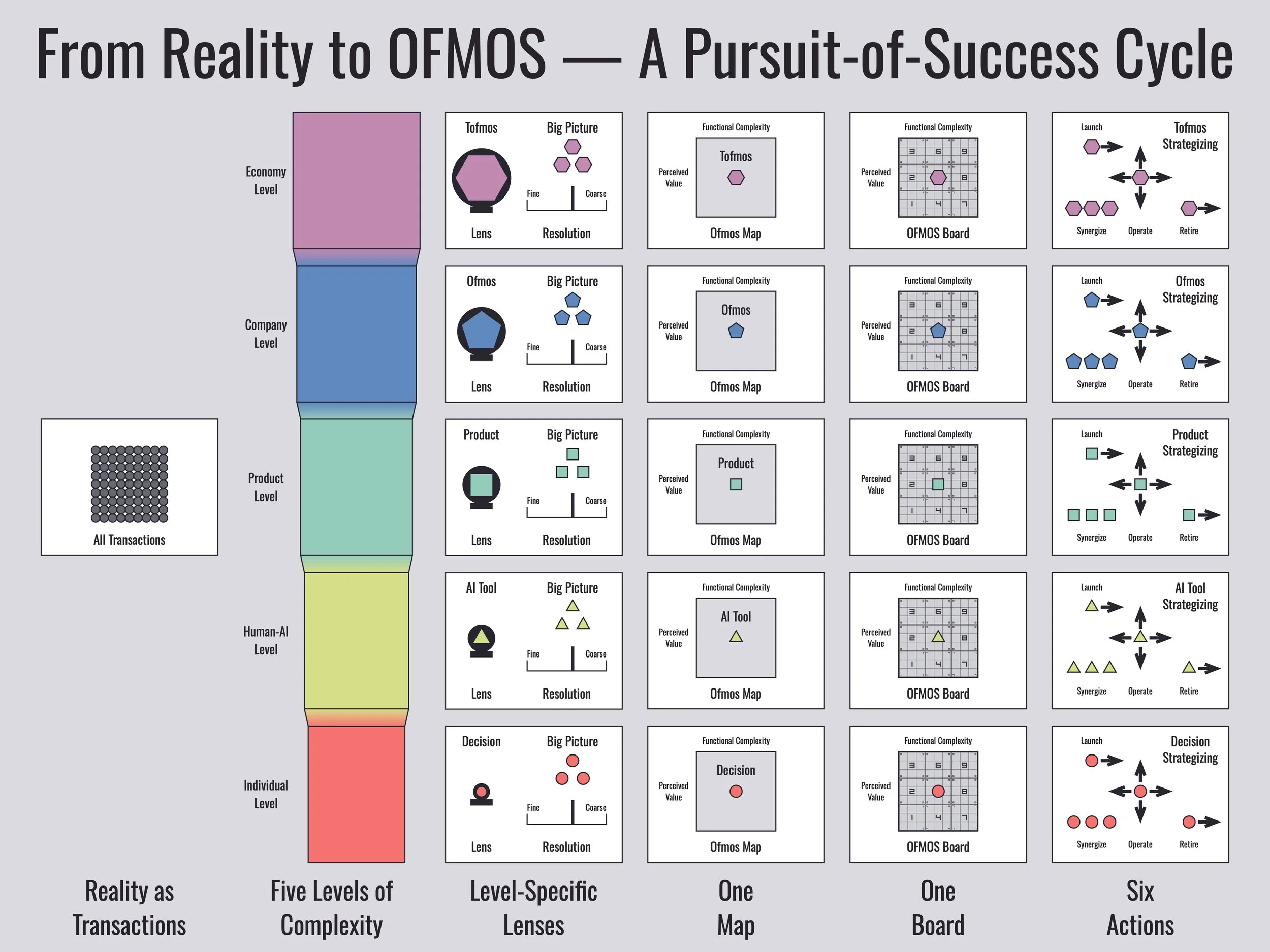
Each of us is navigating a complex and evolving world, every day. To do this well — to take effective strategic actions in pursuit of the subjective overarching goal "successful existence" — we need to understand the world at the different levels at which human activity organizes itself.
That is what the Five Business Big Pictures, our strategy framework, sets out to do. It identifies five levels of reality at which strategic thinking operates — Individual, Human-AI, Product, Company, Economy — and gives the strategist a single architecture for understanding each one and, where the strategist's situation permits, acting on it. At every level, the strategist is the CEO of one entity: the largest coherent entity visible at that level, whose internal structure the strategist can understand, manage, and direct. CEO is a metaphor for human agency at five levels, not a job title. The entity is what the strategist wields in pursuit of successful existence. The entities increase in scope as the levels do, the boundary of the self moving outward, from one's own cognition, to the AI-augmented mind, to a product portfolio, to a company, to an economy. But the architecture of strategic agency is the same at every step.
This visualization puts that integrated perspective and system architecture into a single image. It reads from left to right, from the world as it is observed to the strategist's actions on it; and from right to left, because those actions become new transactions in the world. And the cycle keeps going. What follows is a guided tour: from the real world to the strategist's actions and back. The OFMOS family of games and simulations is in the illustration because that is how the framework gets internalized fastest — turning a permanent lens or mental model for action that takes a career to develop through experience into one a strategist can build through play.
1. The transactions — the world before any clustering rule is applied
Look closely at any region of the business and economic world — in fact, any aspect of our lives — and you find transactions. Two parties exchange something, and value passes between them. A purchase, a contract, a wage paid for an hour of work — all transactions. Less obviously, so is a decision-action transaction: a person committing to an act in the world and receiving, in return, some increment toward their pursuit of successful existence. Monetary exchange is the visible case; value exchange is the broader one.
The leftmost column of the illustration draws this as a field of dots. Each dot is a transaction. Together, across all the people in the economy and across whatever stretch of time matters, the dots are the economy in its rawest form, before any interpretive clustering rule is applied. The same field of dots underlies every way the strategist might choose to read it. What changes between readings is the rule the strategist applies — not the underlying transactions.
2. The continuum of complexity — five bands on a single rise
The transactions are not random noise. Shared needs attract shared solutions, and shared solutions attract more people with similar needs. Solutions that fit needs lead to shared generating capabilities. In markets generally, clusters form driven by both the customer side and the provider side. A decision-action transaction relative to the individual is a cluster. A product relative to a market is a cluster. More complex objects — an ofmos (offering-market cosmos), a tofmos (total offering-market cosmos) — are also clusters. Each is what the transactions look like once enough of them have cohered at a particular level of organization.
The rising organization is itself a continuous structure — what the framework calls the continuum of complexity, the same continuum for any observer. The illustration shows it on the left side: five colored bands stacked from bottom to top, shading into one another at the boundaries. Each band names one level — Individual, Human-AI, Product, Company, Economy. The bands are anchor points where qualitatively new phenomena emerge, not sealed compartments. An AI tool portfolio shades into a product portfolio, which — once it spans multiple distinct markets — shades into a company. The framework names the levels at the points where the dominant dynamics shift.
To capture the patterns that emerge at higher levels, more transactions must accumulate across wider scope and longer time. A single decision-action transaction can be observed in an instant. An ofmos requires enough transactions across many customers within its market, over enough time, for the pattern to stabilize. A tofmos requires more still — across many vendors, many customers, and the longer time it takes for an industry's behavior to settle. Higher-level objects need enough transactions across enough scope and time to support them — a principle complexity science has held for decades, and the visual reason the higher bands are wider than the lower bands.
3. The microscopes — five visual tools, five independent dials
If the continuum is the territory, the metaphoric microscopes are the visual tools the strategist uses to read it. The illustration shows them one per level, because each is specialized for seeing a particular kind of object — and each has its own resolution dial for bringing that kind of object into focus.
Five tools and not one because each level is observing a different system. The Individual Level microscope reads decisions. The Human-AI Level microscope reads AI tools as cognitive instruments. The Product Level microscope reads products. The Company Level microscope reads ofmos. The Economy Level microscope reads tofmos. Each applies its own clustering rule — its own way of grouping the underlying transactions into the level's emergent objects.
Each clustering rule is itself a structured thing: a small set of conditions that all have to hold together for the cluster to count as that level's kind of object. These are the level's constitutive conditions: the specific things that, taken all at once, make the cluster what it is. Drop any one of them, and what you have stops being that kind of object. For example, two of the conditions for an ofmos at Company Level are an offering and a set of customers sharing the same need — without either, there is no ofmos.
The dial of each microscope sets the resolution, or scale, at which the clustering rule is being applied. The dial does not change that rule; it controls how completely the rule's constitutive conditions are being enforced. There is one position on each dial — the broadest resolution at which all of the constitutive conditions are fully enforced — where the rule produces the level's emergent objects as coherent wholes. The view at that position is the level's big picture: the portfolio of the level's emergent objects made visible as a coherent whole.
Off that position, the level's own constitutive conditions weaken, and the level's own objects deform — fusing into each other if the dial slides coarser, fragmenting into spurious sub-objects if it slides finer. The Company Level dial does not reveal products by going finer or tofmos by going coarser. The next level requires a different microscope.
4. The Ofmos Map — the same reference system at every level
Once a microscope produces a coherent view of its level's emergent objects, the strategist needs a reference system to place them. That is what the Ofmos Map does. The illustration shows the Ofmos Map at each level, with one of that level's emergent objects placed on it.
A note on vocabulary: in this post, an offering is whatever addresses a need — a product, a service, a tool, an experience, or an action.
The map's two axes are the same at every level. Vertical: perceived value — how much the offering contributes to the customer's pursuit of successful existence, derived from the framework's account of needs as a hierarchy. Horizontal: functional complexity — what it takes to produce the offering or execute the action. A decision sits on these two coordinates. So does an AI tool, a product, an ofmos, a tofmos. The entities at each level differ; the dimensions that locate them do not. This is the framework's central unification: the same two-dimensional reference system reads every level's emergent objects.
At each level, you are the CEO of one entity — the largest coherent entity visible at that level, whose internal structure you can understand, manage, and direct. You wield this entity as an instrument in your pursuit of successful existence.
From a general perspective, where the system at each level must be indefinitely sustained, a structural requirement comes into view — what the system needs from its own dynamics to keep going over time, present even without competitive pressure around. This structural requirement can be seen as the foundational layer of the formula for success at that level. The strategist's full formula for success includes this foundational layer and adds the contextual moves their specific situation calls for. The level subsections that follow name the structural requirement at each level.
Individual Level — the CEO of your own mind
The unit of analysis at this level is the decision-action transaction: an articulated intent, an action that follows, an interaction with the environment, and a return — a contribution to your pursuit of successful existence. The four stages can chain into coordinated sequences. In a game of chess or OFMOS, for example, you might sacrifice a piece in the short term to set up a larger gain a few moves later. The intent is the trade. The action is the sacrifice. The interaction is your opponent's response. The return arrives a few moves later, when the larger gain materializes. That is a small example of coherent thinking — something most of us do constantly without naming it.
A note on terminology at this level: The decision-action transaction is the unit of analysis — a single instance of the four-stage cycle (intent, action, interaction, return). What the strategist actually manages, though, is not single instances but recurring decisions: the standing moves the strategist commits to and refines over time. The illustration shows these as the object on the map and the board. A decision in this sense is a single thing the strategist can launch, retire, or innovate, even though it expresses itself as many decision-action transactions over time.
Your instrument is your own cognition. The big picture at this level is your full stream of decisions, seen all at once. The structural requirement at this level is coherence — keeping the decisions aligned with the evolving structure of your needs, with the goal of a unified mental model.
Human-AI Level — the CEO of your AI tool portfolio
The unit of analysis at this level is the AI tool, considered both individually and as part of a portfolio. An AI tool, in the framework's sense at this level, is a cognitive instrument — one that participates in the thinking process itself, not just executing decisions faster. Imagine yourself running four such tools: a research-synthesis tool, a drafting tool, an editing tool, a fact-checking tool. Through the Human-AI Level microscope, those four are visibly a coordinated cognitive system, with deliberate boundaries — research delegated, drafting human-led with tool acceleration, editing collaborative, fact-checking automated under your audit. Slide the dial coarser and the four merge into "tools I use," then "AI in my workflow." Slide it finer and each tool fragments into the prompts that ran through it last week.
Your instrument is your AI-augmented cognition. The big picture at this level is your full set of AI tools seen all at once as a coordinated cognitive system. The structural requirement at this level is cognitive alignment and AI tool synergies — the portfolio aligned with your judgment, the tools working as a deliberate system rather than a stack of independent apps, with the goal of augmented judgment: a decision-making capability qualitatively different from either you alone or the tools alone.
Product Level — the CEO of your product portfolio
The unit of analysis at this level is the product. The framework introduces a simplification: products are treated as belonging either to a single shared market or to non-overlapping unique markets. The simplification lets the strategist reason about portfolio dynamics without yet managing the multi-market complexity that becomes central one level up. On the Ofmos Map, each product holds a position by its perceived value and its functional complexity. Customers learn over time, and the perceived value of every offering erodes — the commoditization force the framework names. Products drift downward on the map unless the strategist acts.
Your instrument is your product portfolio. The big picture is your product portfolio on the map. The structural requirement at this level is product synergies. The strategy that builds on this requirement involves managing portfolio interdependencies, the commoditization force, and the strategic logic of innovation, rather than optimizing individual products in isolation.
One contemporary case fits cleanly here. If you are managing AI tools that other people use — AI tools as a business — you are managing a product portfolio, regardless of the AI inside the products. The cognitive-instrument framing of Human-AI Level applies to your customers' experience of the tools. Your own strategic position is one level up: you are the CEO of a product portfolio, and the dynamics that govern you are the dynamics of products in markets. AI tools sold to customers are one case among many at this level — software, hardware, services, physical goods all sit here too.
Company Level — the CEO of your company
The unit of analysis at this level is the ofmos (offering-market cosmos), defined by three constitutive conditions: an offering, a set of customers who share the same need-addressing behavior, and a resulting stream of profit over time. Need-addressing behavior means the same need and the same hierarchical context that need sits in within the customer's broader need tree. Two customers buying the same hammer to drive the same nail are in different ofmos if one is building a deck for summer family gatherings and the other is hanging a single picture in an apartment. They share the product and the surface need, but their hierarchical contexts differ, and that gives them two distinct ofmos with two distinct commoditization trajectories.
On the Ofmos Map, each ofmos has its own position. Through this level's microscope, you see the portfolio of ofmos as a whole, every ofmos at its position on the map. As the dial slides coarser, the constitutive conditions weaken and ofmos start fusing into each other: the deck-builder and the apartment-hanger ofmos blur into a single cluster of everyone who buys this hammer to drive a nail; nail-driving and demolition merge into hammer use in general; hammers and screwdrivers fuse into hand tools. As the dial slides finer, ofmos fragment into spurious sub-clusters — the deck-builder ofmos splits into Saturday deck-builders and Sunday deck-builders, into deck-builders using one nail size versus another — and the level's patterns dissolve into noise.
Your instrument is your company, viewed as a system of ofmos. The big picture is your ofmos portfolio on the map. The structural requirement at this level is Ofmos Portfolio Alignment: keeping the portfolio's Center aligned with the Focus, the area on the map where you, as the CEO, intend the company's center of gravity to sit. The strategy that builds on this requirement is portfolio adjustment as every ofmos commoditizes and the Center drifts.
Economy Level — the CEO of your economy
The unit of analysis at this level is the tofmos (total offering-market cosmos), defined by three constitutive conditions paralleling those of the ofmos: an offering category, a set of customers who share the same need-addressing behavior across all vendors operating in that need-space, and an aggregate stream of profit over time. Loosely, a tofmos is an industry viewed as a behavioral pattern in the economy rather than as a collection of companies. Each tofmos is the economy-level signature of many ofmos accumulating around the same need-space.
On the Ofmos Map, each tofmos has its own position — the position shared by all the ofmos within it. Through this level's microscope, you see the economy as a whole — every tofmos at its position on the map.
Your instrument is the economy. Economies compete with other economies on the position and shape of their tofmos portfolios, and the economy you wield is what you bring to that competition. The big picture is your portfolio of tofmos on the map. The structural requirement at this level is Tofmos Portfolio Dispersion — a portfolio spread broadly across the map rather than bunched in a narrow band, with the goal of an economy that does not become structurally fragile. The strategy that builds on this requirement is creative destruction — old tofmos giving way as they commoditize, new tofmos taking root at higher positions.
5. The OFMOS board — the map made physical
The Ofmos Map is an analytical instrument. It tells the strategist where things stand. But strategy is not only an analytical activity — it is a practice that develops through repetition under pressure, the way any practiced capability does. The OFMOS family of games and simulations, developed independently of the framework but built on its structure, provide a particularly good vehicle for that practice. Their board is the Ofmos Map made physical, which gives play structural fidelity to the framework's dynamics.
The board's standard layout is a 9-by-9 grid. The 81 positions simplify the continuous Ofmos Map into a discrete space that two or more strategists can play across. The level-specific object — a decision at Individual Level, an AI tool at Human-AI Level, a product at Product Level, an ofmos at Company Level, a tofmos at Economy Level — sits on the board as a game piece, occupying one of the 81 positions and moving across the board as the strategist's actions reposition it.
The simplification is what makes practice possible. A continuous map is the right instrument for analysis: it shows position with whatever precision the strategist's reading of the world supports. A discrete board is the right instrument for play: 81 positions are coarse enough that an opponent's move is legible at a glance, that the strategist can feel the pace at which a piece is drifting downward under commoditization, that a portfolio's shape on the board is recognizable as a configuration. And 81 positions are fine enough that the structure of the map — its perceived-value axis, its functional-complexity axis, its regions — is preserved. The same board works at every level because the map does, and because the coordinates that locate the level's emergent objects are the same at every level.
What the board adds is participation in the dynamics. Reading about commoditization is one thing; watching a piece you launched three turns ago drift downward turn after turn, seeing the associated profit diminish, until you must either innovate it back upward or retire it, is another. The OFMOS games make the framework's structural forces — commoditization, innovation, synergy, portfolio dispersion — into things the strategist participates in rather than only reads about. The board makes the framework physical.
The games also reshape the structural requirement itself, but not in the way a casual reading might suggest. In real life, the system must keep going over time, which means generating returns sufficient to sustain itself — not eventually, not on average, but continuously enough to survive. In play, the horizon is finite — a session or a planned series of sessions — and the strategist maximizes returns within that horizon. Both demand returns; what differs is the timeframe over which they must show up. That compression is what makes practice possible: the strategist sees a portfolio's whole arc in one sitting that, in real life, would unfold over years.
6. The strategizing actions — six actions, same at every level
Finally, we arrive at the strategist's actions — the six actions you can take at each of the five levels, on the object the strategist manages at that level. Launch introduces a new emergent object into the portfolio. Commoditize deliberately accelerates an object's downward drift to extract remaining value. Innovate upward repositions the object toward a higher-value need. Innovate rightward adds functional complexity to escape commoditization. Innovate leftward reduces functional complexity to capture a position a more complex offering has overshot. Retire removes the object when it no longer earns its place. Synergy is not a seventh action but an event triggered by the actions — a payoff that arises when the objects on the map sit in coordinated arrangements.
The six actions translate across levels, with the object the action acts on changing by level. A launch is the commitment to a new decision at Individual Level, the addition of an AI tool at Human-AI Level, the introduction of a new product at Product Level, the addition of a new ofmos at Company Level, the emergence of a new tofmos at Economy Level. A retirement is the dropping of a decision that no longer fits the strategist's evolving needs at Individual Level, the removal of an AI tool from the portfolio at Human-AI Level, the discontinuation of a product at Product Level, the exit from an ofmos at Company Level, the dissolution of a tofmos at Economy Level. The other four actions translate the same way: each names a kind of move that holds across levels, and the level supplies the object the move acts on.
These six actions, applied through the level's big picture in pursuit of the level's formula for success, are what strategy consists of in the framework. The OFMOS game mechanics make the CEO's actions playable, which is where the framework becomes practice rather than theory.
Closing the cycle — strategy as the strategist's life
Read the illustration left to right and the story is: transactions in the world organize themselves into emergent objects across five levels of complexity. Each is readable through a level-specific microscope, placeable on a shared reference system, playable on a simplified board, and actionable through a defined set of strategic actions.
That is the outbound direction. The return is what the strategist's actions do back to the world. The actions on the right of the illustration generate transactions on the left. A product launched on the right is a new bundle of customer purchases and experiences entering the world on the left. The next pass of the microscope reads a world the strategist's prior actions helped shape. The strategist chooses again, and the world is a little different than it was. This is the pursuit-of-success cycle.
What the illustration shows is a representation of what the strategist is already doing whenever they pursue what they want — choosing actions, generating transactions, reading how the world responds, choosing again. It makes that loop visible and gives the strategist instruments to participate in it more deliberately. What produces a permanent lens, rather than another framework alongside others, is the assembly — the foundational theories, the strategy framework, and the games. The framework turns the theories into a five-level lens for action; the games turn the theories' analytical architecture into a playable form. After enough engagement with all three — reading the foundational documents, working with the framework, playing the games — the framework's vocabulary is the strategist's own.
For the foundational theories (One-Need Theory of Behavior, Ofmos Theory of Business), the strategy framework (the Five Business Big Pictures), and the OFMOS® family of games and simulations, see ofmos.com.